Stop punting bomb pots.
Your game runs double board bomb pots every orbit and nobody at the table knows the answers. Play full hands against solved opponents, get graded street by street in big blinds lost, and find out whether you ran bad or played bad.
No card required. No real-money play, ever.
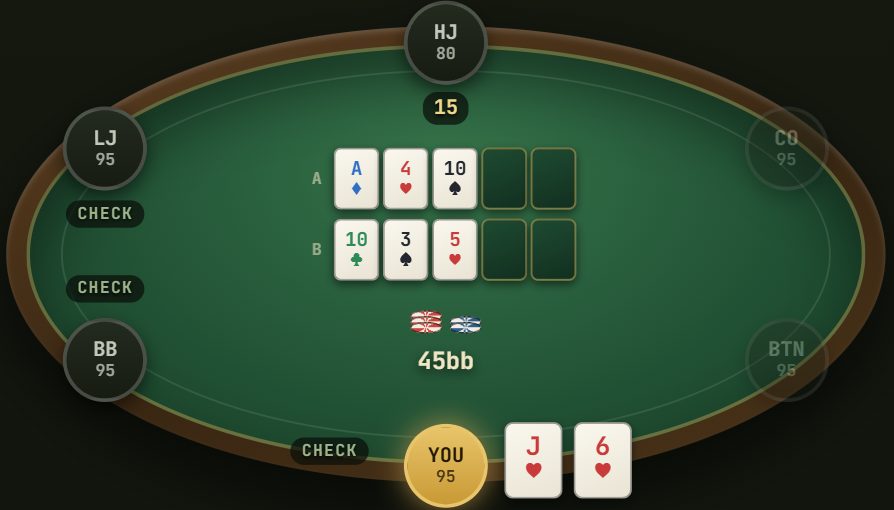
Never played one? Two ideas and you're caught up.
If your game just started running these and the table lingo lost you, everything on this page comes down to two rules. Here they are in plain language.
1 · Everyone antes, everyone's in
In normal hold'em, a round of betting thins the field before the flop. A bomb pot skips it: every player posts an ante (a forced bet) and the hand goes straight to the flop with the whole table still in. No preflop raising, no folding, no choosing your spots. Games that run them trigger bomb pots at random, typically with an ante of 2 to 4 big blinds.
6 players ante 3bb each and the pot is 18bb before anyone bets. A typical raised pot in normal hold'em starts around 5 to 7bb with two players. A bomb pot starts three times bigger, with the whole table live.
And since nobody chose to play the hand, everyone arrives holding any two cards. That one fact rewrites correct strategy more than most players realize.
2 · Two boards, one pot
Most bomb pots today run double board: two complete boards run out side by side, two flops, two turns, two rivers. There's still one pot and one round of betting per street, and your bets count toward both boards at once.
At showdown the pot splits in half: best hand on Board A wins one half, best hand on Board B wins the other. Win both and you scoop the whole thing. Tie with someone on a board and you chop that half.
Here's the heart of the format: half-pot wins mostly hand you back your own chips, because you funded the pot too. The real money is in scooping, and in dodging the spots where an opponent can scoop you. Every strategy idea in this tool traces back to that.
A free account includes LEARN THE GAME, a six-lesson course from "what's an ante?" to your first study session, plus 10 trainer hands a day on any solve in the library.
possible double board flops, counting suits as interchangeable. 450+ are solved and certified in the library, NLHE and PLO. Solve any of the rest on demand with Pro.
Ran bad, or played bad?
Every hand ends with two numbers. Net is the chips you actually won or lost. EV is what the hand was worth on average when the money went in. When they split by more than half a blind, the hand gets tagged, so a perfectly played cooler finally reads as what it is: variance, not a mistake.
Turn all-ins enumerate every river exactly. Flop all-ins sample 6,000 runouts. No hand-waving.
Train like it's a real session.
You're dealt in at a random seat, SB through BTN, and play the whole hand with no interruptions and no answer leaks. The full review lands when the hand ends: every decision scored by EV lost, with the solver's complete mix on the table.
Fair grading, guaranteed
Pick the solver's favorite action and you can never grade worse than GOOD. When EV noise contradicts the frequencies, the decision is tagged and kept out of your stats.
Leaderboard and leak profile
Lifetime record, today's line, average cost per decision, and a leak profile that shows where the EV goes. Compete under a table name on the leaderboard, or opt out entirely.
Built for the couch
Installs as an app on your phone. The full table auto-fits any screen, so you can grind reps between sessions.
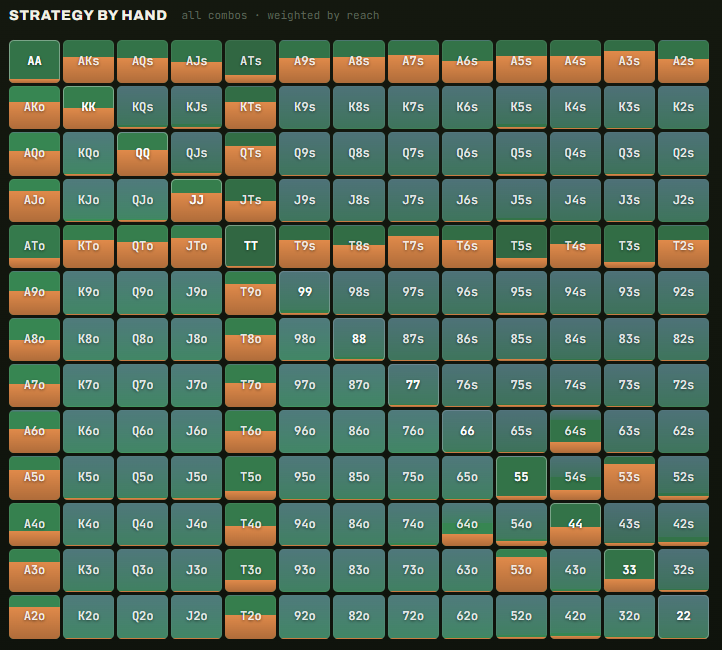
Study the whole tree.
Every node on both boards, not a heads-up approximation stretched past its limits.
Your exact four cards
Type or tap your PLO hand into My Hand and get its full strategy, EV in bb, and strength rating on each board, with real example hands from its group to compare against.
Node lock the fish Coming to Elite
Your game never checks back the flop? Soon you will lock that node to how the pool actually plays, re-solve, and study the punish. Exact hands on NLHE flops, strength regions everywhere else.
Reports across your library
Aggregate tendencies mined from every saved solve: first-in aggression by table size, betting by board-texture pair, fold-vs-bet rates, showing where whole texture classes play differently on two boards.
Your solver has never seen this game.
Two boards, one pot
Standard tools model one board. Bomb pots split equity across two runouts at once: hand values, bet sizing, and bluffing geometry change from the flop on. Half the pot per board, ties split within each half.
Truly multiway
Everyone antes, everyone sees the flop. Solutions run from heads-up to 6-handed, the spots other tools skip entirely.
Antes from the stack
The game tree gets the rules right: antes come out of your stack, so a 100 bb hand can never cost 105. Bet sizes and all-in spots are computed against your real stack behind.
Cheaper than one punted pot.
Start free: train on the whole library, study the samples. Upgrade to see every answer, or for custom solves on your exact lineup.
Free
Kick the tires. Real solutions, small doses.
- ✓ 10 trainer hands a day, dealt from any solve in the library, EV-graded
- ✓ 6 sample solves (NLHE and PLO) opened all the way: full solution, ranges, strategy matrix
- ✓ Leaderboard, per-street stats, hand-end review
Library START HERE
The whole solved library, and every hand you actually played.
- ✓ Unlimited trainer, no daily cap
- ✓ The strategy matrix on every spot, before or after each decision
- ✓ Open the full solution of every library solve: ranges, runouts, blockers, reports
- ✓ Presolved library: 450+ unique NLHE and PLO bomb pots, every one at certified depth
- ✓ 2 to 6 players, flop to river, both boards
- ✓ Solved at the real game: CoinPoker's actual 5% rake and random 2 to 4bb antes, verified against real hand histories
- ✓ Paste your CoinPoker hand history straight in, no files: graded street by street, replayable on the felt
- ✓ 1 full-depth hand grade a month, your hand solved at certified quality
- ✓ Unlimited trainer with per-street EV grading, leaderboard, full reports
- ✓ NEW Texture Match: imported hands graded against the closest solved board
Pro
Your exact hand, fully solved. No other tool can compute these.
- ✓ Everything in Library
- ✓ 80 custom solve credits a month, the annual allowance
- ✓ Custom solves run at full library depth, the same certified quality
- ✓ Grade any imported hand: an unsolved spot runs a full solve first (1 credit) and the grade follows
- ✓ Your stacks, your lineup, tuned reference settings
- ✓ Certified accuracy: every solve ships with a measured exploitability score
Elite FULL TABLES
Full-ring bomb pots, measured on the same ruler as the library.
- ✓ Everything in Pro
- ✓ 7 to 9 player custom solves and hand grades, GPU-solved, every one measured against the strongest opponent we can train
- ✓ 150 custom solve credits a month, monthly or annual
- ✓ A 14-day study window on every 7 to 9 player hand you grade: walk your real line, node by node
- ✓ Two lanes on every 7 to 9 player solve: Priority on a cloud GPU, or Overnight at half the credits
- ✓ Your solves stay in your library: 2 to 6 player solves always, and up to 30 full-ring solves at a time (pin the ones that matter)
- ✓ Deep dives: re-solve any NLHE spot with up to 3 bet sizes per street and a raise cap of 4, from 1 credit
- NEXT Node locking: pin any decision and re-solve around it
- NEXT GPU-finer PLO abstraction
The library hit its certification bar (the exact numbers are published on this page), and the first 50 people get it for life. Pay $599 once and keep every certified solve forever, including everything we add. Founders also keep a permanent Pro rate: $80/mo or $720/yr, the compute only, because the library part is already yours.
the catch: founder pricing funds the ramp-up, and when the 50 are gone this tier closes for good.
Our margin of error, measured by the hardest opponent we can build. A trained best response attacks every library solve, and the most a perfect exploiter could win back per hand, as a share of the starting pot, is published per table size below with the bar each size clears today. Every board is certified before it's published, and we aim for 1% (heads-up and 3-handed), 1.5% (4 to 5 players) and 2% (six-handed and up). Whenever the solver has spare time, it keeps re-solving boards deeper, toward 1% everywhere.
See the exact numbersA standard custom solve uses 1 credit; deep accuracy (NLHE or PLO) adds 1 on tables of 5 or more and is free on 2 to 4 players. On Elite, 7, 8 and 9 player solves use 3, 4 and 5 credits (deep accuracy adds 1). More bet sizes or a higher raise cap add 1 credit per 12 GB of solve, shown in the quote before you pay. Every credit buys a full equilibrium computation on dedicated hardware, not an instant AI approximation. Cancel a queued solve before it starts and the credit comes straight back. Unused monthly credits do not roll over; top-up packs (10 credits for $20) never expire. Cancel anytime and keep access through the end of the paid period.
The only tool built for this game.
Mainstream solvers are brilliant at single-board, heads-up poker. Bomb pots are neither.
| BOMB POT SOLVER | MAINSTREAM SOLVERS | |
|---|---|---|
| Double board games | ✓ The entire product | Not modeled |
| Postflop players | ✓ 2 to 6 in the library, 7 to 9 on Elite, every street, both boards | 2, rarely 3 |
| Bomb pot antes from the stack | ✓ Native | No preflop-less format |
| Your real hands, graded | ✓ CoinPoker import, grade, replay | Not for this game |
| A solve of your exact hand | ✓ 1 credit (2 with deep accuracy at 5+ players) | Impossible at any price |
Reviews take time. Numbers don't.
Bomb Pot Solver is new. Rather than invent customer quotes, we publish something stronger: the measured accuracy of every solve, checked by independent best-response passes, right on this page. Play the ten free trainer hands a day; if the solver earns a review, send it and it goes here with your name on it.
Deal me in →One email when we publish something worth your time: a solved spot breakdown, a leak the trainer data keeps showing, a library milestone. No schedule, no filler, unsubscribe in one click.
Questions, answered.
What is a double board bomb pot?
Every player posts an ante and skips preflop. Two full boards are dealt, and the pot is split between the winner of each board. It plays deep, multiway, and nothing like standard poker, which is why standard solutions don't transfer.
Which games and player counts are covered?
No Limit Hold'em and Pot Limit Omaha, 2 to 6 players in the library, on both boards from flop through river, with real position names from SB through BTN; Elite solves and grades 7 to 9 handed on demand. The library is organized by game and configuration. There are 9.27 million distinct double board flops once suits are treated as interchangeable: the library covers the common textures at certified depth, look-alike matching grades hands on nearby boards, and Pro solves any of the rest on demand.
How accurate are the solutions?
Each solve runs to a target exploitability measured in big blinds, and each library solve ships with a measured exploitability score from independent best-response passes. Multiway solutions are low-regret strategy profiles, the practical standard for these games, rather than a provably unique equilibrium. Every board is certified before it's published, and we aim for 1% (heads-up and 3-handed), 1.5% (4 to 5 players) and 2% (six-handed and up). Whenever the solver has spare time, it keeps re-solving boards deeper, toward 1% everywhere.
| CONFIGURATION | DEEP-CHECK TOTAL | % OF POT | BAR TODAY | AT THE 1% GOAL | |
|---|---|---|---|---|---|
| measuring… (live from the app) | |||||
Every board in the library, NLHE and PLO alike, is certified at its deepest save. Each range spans every board of that player count; the bar is set per table size (bigger tables, bigger pots, bigger trees) where the certified library lands under the current check, and it moves down as boards are solved deeper. The last column counts the boards of that size already at or under the 1% goal; the per-size targets are 1% heads-up and 3-handed, 1.5% at 4 to 5 players and 2% six-handed and up. The badge on each library entry is the per-board truth.
How it is measured: a trained best response attacks each finished solve on the GPU, five independent passes with seeds derived from the save name, and the total EV a perfect exploiter could win back is quoted with a real standard error. The exploiter's training budget scales with the size of the game tree. Ruler: 16× the training budget of the Aug 23 check, in force since Sep 5, 2026; the check converges there (doubling the budget again moves the readings by a few percent), so the numbers rose and the solves did not change. Every number above comes from that check.
What is EV?
EV means expected value: what a decision is worth on average if you made it in the same spot thousands of times, measured in big blinds. It counts from the start of the hand, so folding shows as minus your ante. The solver puts its weight on the options with the highest EV. A single hand's result is luck: a call that is 0.6 big blinds worse than folding still wins sometimes. EV tells you whether the decision was right.
What does the percentage on a solve mean?
It measures how close the strategy is to unbeatable. After a board is solved, we train the strongest opponent we can for every seat. It knows the strategy exactly and plays tens to hundreds of millions of hands to learn how to exploit it, then hundreds of thousands to millions more to measure what it wins. The percentage is how much more those opponents win than the strategy itself would in the same seat, per hand, added up across every seat, as a share of the starting pot. Six-handed at ante 3 the pot starts at 18 big blinds, so 1% means 0.18 big blinds a hand, all six seats added up. It is not your win rate and it is not your equity. Smaller is better, and zero would be perfect.
What does "certified" mean?
A board is certified when its measured percentage is under the bar for its table size (4.15% six-handed, 3.45% heads-up). Boards keep getting solved deeper toward 1% (our published targets are 1% to 2% by table size), and every board shows its own number, so you can see how far to trust it before you study it.
Is the trainer's grading trustworthy?
Yes, and it's honest about noise. Per-action EVs are Monte Carlo estimates; when they contradict the solver's own frequencies, the frequency-consistency guard sides with the frequencies and keeps the noisy number out of your stats. Matching the solver's top play never grades below GOOD.
Does it work on my phone?
Yes. The app installs as a PWA and the trainer table auto-fits any screen, so you can run hands from the couch or between sessions.
Why can't I just use PioSOLVER or GTO Wizard for this?
Mainstream solvers model a single board and, postflop, almost always just two players. Bomb pots are multiway by definition and split across two boards, so hand values, bluffing math, and equilibrium strategies are fundamentally different. This engine was built for the game from scratch. And the instant custom solves mainstream tools advertise are single-board, mostly heads-up AI approximations; when compute genuinely costs them money, they meter it with credits just as we do.
Is this legal to use while playing?
Bomb Pot Solver is a study tool, like any solver or training site. Using real-time assistance while playing violates the rules of virtually every poker site and card room, and we don't support or condone it. Study away from the table, then bring what you learned.
I'm new to solvers. Is this for me?
Yes. The Trainer is the easiest on-ramp: play hands, get graded, and read the explanations. You'll absorb the strategy long before you open a matrix, and the matrix will be waiting when you're ready.
Is this a gambling site?
No. Bomb Pot Solver is a study tool. There is no real-money play, no wagering, and no integration with any poker site.
Your game already runs bomb pots. Now you can study them.
Ten free trainer hands a day, no card required.
Deal me in